
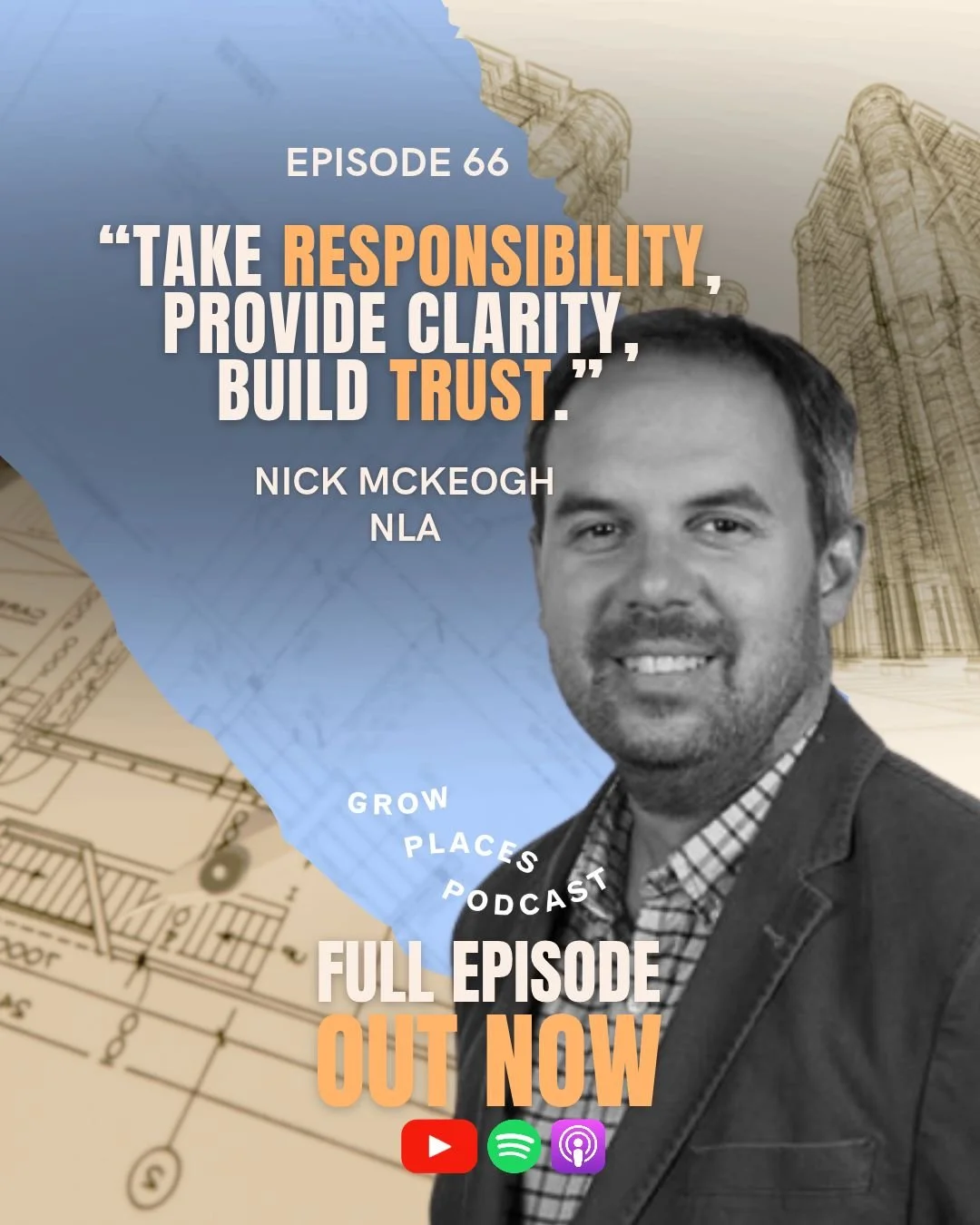
"If you take responsibility, if you provide clarity, then you will build trust."
Nick McKeogh, NLA
Hi everyone,
Welcome to the November edition of Grow Places Insights.
These conversations brought together two people who spend their working lives trying to get the built environment understood by the people it serves. Muyiwa Oki is an architect at Mace and a former president of the RIBA. Nick McKeogh is co-founder and chief executive of NLA, which gives London's planners, architects, developers and contractors somewhere to talk to each other, and to the public, rather than scuttle off to their own corners.
On the surface, their worlds look different, one inside a global consultancy, the other running a neutral convening body for a city. Yet both conversations circled back to the same question: what does it actually take for development to be believed, not as a campaign run once a scheme is in trouble, but as part of how a project is set up?
The answer, as both guests made clear, is not found in a better presentation. It is found in plain words, in turning up, and in giving people something real to look at, started early enough that trust is already there when the difficult decisions arrive.
Primary Colours and the Thread That Ties It Together
"Most people just want to know that they are being heard."
Muyiwa Oki, Mace
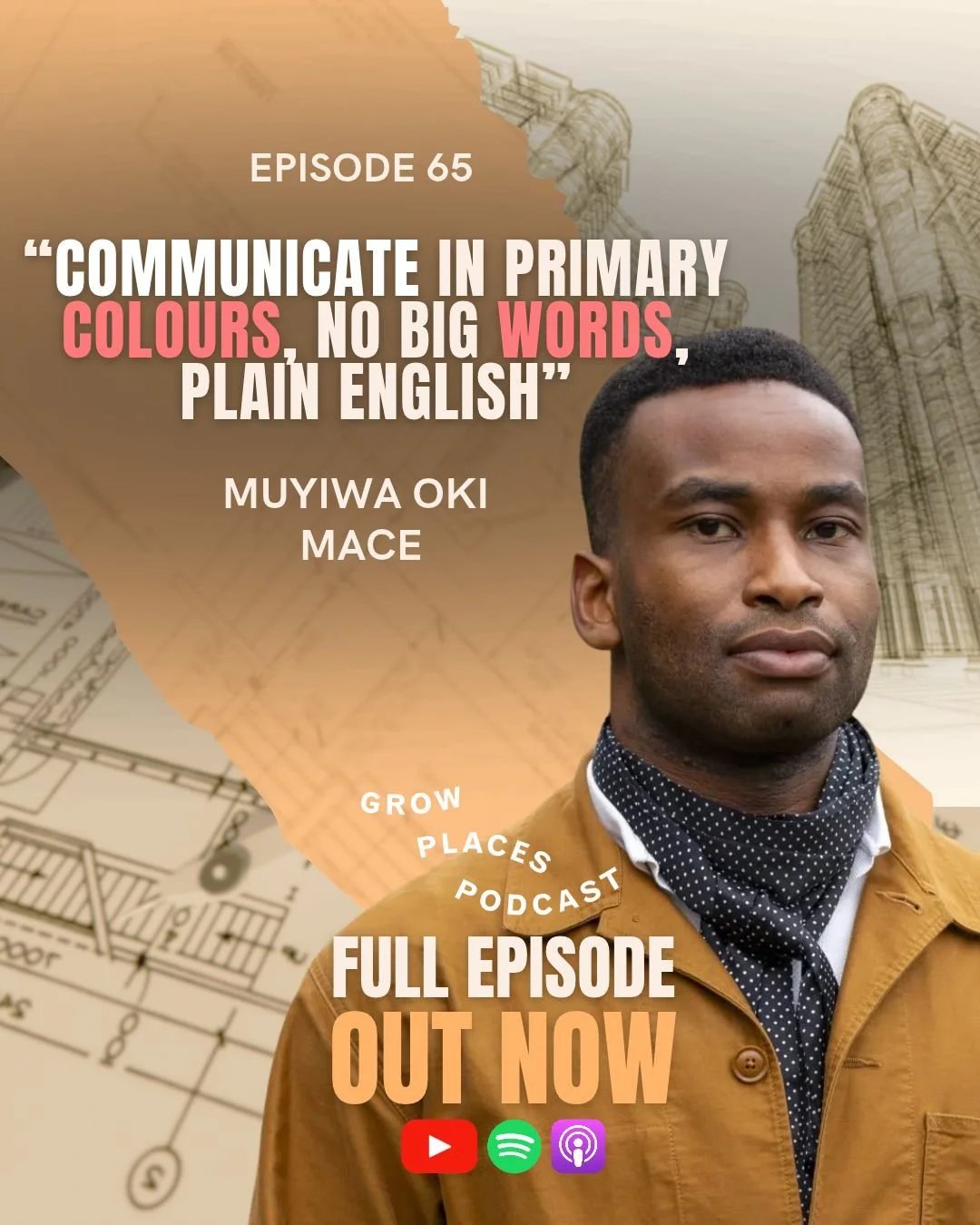
Muyiwa's first week as RIBA president brought the RAAC concrete crisis, and with it a request to speak for the profession on television news after a briefing only a couple of days earlier. What he took from it was a rule he calls communicating in primary colours, no big words, and he now treats it as a core skill that everyone needs.
"Talk in plain English."
For Muyiwa, plain English is not only for the public. He describes technical understanding as a core competency for an architect, and the job as translating it into something usable, which is why he joined Mace. On a bid for a large international site, he recalled, the conversation had been about answering the questions asked, until his team began working with the engineers on what it would look like for the end user. It is easy, he said, for each consultant across a project's life to think about their own bit, their own square, while only one looks at the thread that ties it all together and what the output looks like.
"Architecture is super important because it's the glue that binds the project together."
That is also why he wants architects grounded technically, from the education system up, and sees the principal designer role, which the RIBA led on and which is now a statutory requirement for higher-risk buildings, as giving architects the chance to take control of risk across the whole life of a project, not just the façade.
The same instinct shaped how he used the presidency. He built a calendar into the president's office so that he could visit the RIBA's regions, aiming to see a school of architecture and a couple of practices in as many as he could. Many in the UK saw the RIBA as a London institution, and he says that was part of why he went out. The institution's headquarters came to its members, and he could carry what he heard back to the board.
A Quarter of the Economy, Still Not Understood
"It's 2.7 times bigger than the financial services sector. It's one in eight jobs."
Nick McKeogh, NLA
Nick's starting point was scale. NLA's work with GLA Economics and the LSE looked at the professions that shape places as a single sector, and found that together they account for around a quarter of the economy. He is blunt that this is not understood, and says the sector needs to do what financial services did in the 1980s and the creative industries in the 1990s, which is to get government to see that it is a key industry in its own right, not just a service to others.
Part of the reason, he argued, is that the professions each have their own trade bodies, and they go to government with different asks and tell the public a different story. He says NLA has become a better translator of the languages between them. Too little conversation produces misconceptions, such as that every developer simply wants to extract as much money as possible, or that communities do not want change.
"Everyone's always in a rush, including us."
That is his frustration. Spending time up front, bringing the conversation in before the crunchy bit of development, tends to get outcomes quicker, and he sees AI as adding to the feeling that everything must go faster, which does not create the cities people want to belong in.
"They get more and more excited about a physical model."
At NLA, children run their fingers over the models of London, and a group who brought Roman ruins found everyone picking them up. Nick was also candid that trust does not arrive straight away, and that leaving an awkward issue unraised usually comes back to bite.
Three Reflections We’re Carrying Forward
The first is that communication is not a layer applied to delivery, it is part of how delivery is set up. We tend to treat explaining a scheme as something for once the design is settled, yet both guests describe the opposite, bringing the conversation in before the crunchy bit, when it can still change what gets built. Muyiwa taking the RIBA to its regions and Nick's advice to leave nothing awkward unraised are the same discipline, at the scale of an institution and of a single project. Trust that is built at the start is available when it is needed. Trust that is requested at the end rarely is.
The second is that a sector of this size cannot afford to speak with many voices. If the professions that shape places are a quarter of the economy and still not understood, part of the explanation is that each tells its own story to its own audience, and the public is left to piece them together. Muyiwa describes the same pattern inside a single project, where each consultant tends to think about their own square and only one looks at the thread that ties it together. His primary colours and Nick's translation work are two answers to the same problem, a shared language simple enough to be repeated back by someone outside the industry. That is a communications point, but it is also an economic one, because a sector that is not understood is easy to leave out of the conversation about growth.
The third is that credibility sits in what is hard to fake. As polished digital content becomes cheap and abundant, a simple sentence, a person in the room and a model you can walk around carry more weight, which is why visitors still go to the model. None of this replaces substance, and Nick's point about clarity includes honesty, but it is what gives a good scheme a fair hearing.
Looking Ahead
It would be easy to read these conversations as a complaint about a sector that is poorly understood, but neither guest ended there. Muyiwa's account of the regions is of something simple working. Nick is optimistic that a challenging market is exactly when common ground gets found, because people still need growth and still need their places reinvested in.
What connects both, and what we keep returning to at Grow Places, is that a project is set up well or badly long before the first drawing is issued. Who is in the conversation, what language they share and what they can see and touch are set-up decisions, as much as the structure of the deal or the choice of team. Trust is not something development gets to ask for at the end. It has to be built in from the start.
That is what gives a good place a fair hearing, and it begins with something as plain as saying what we mean, to the people who will live with it.
More soon,
The Grow Places Team
Missed the conversations?
Catch the full podcast episodes at www.growplaces.com/podcast